When Military Power Opens the Door to Private Oil
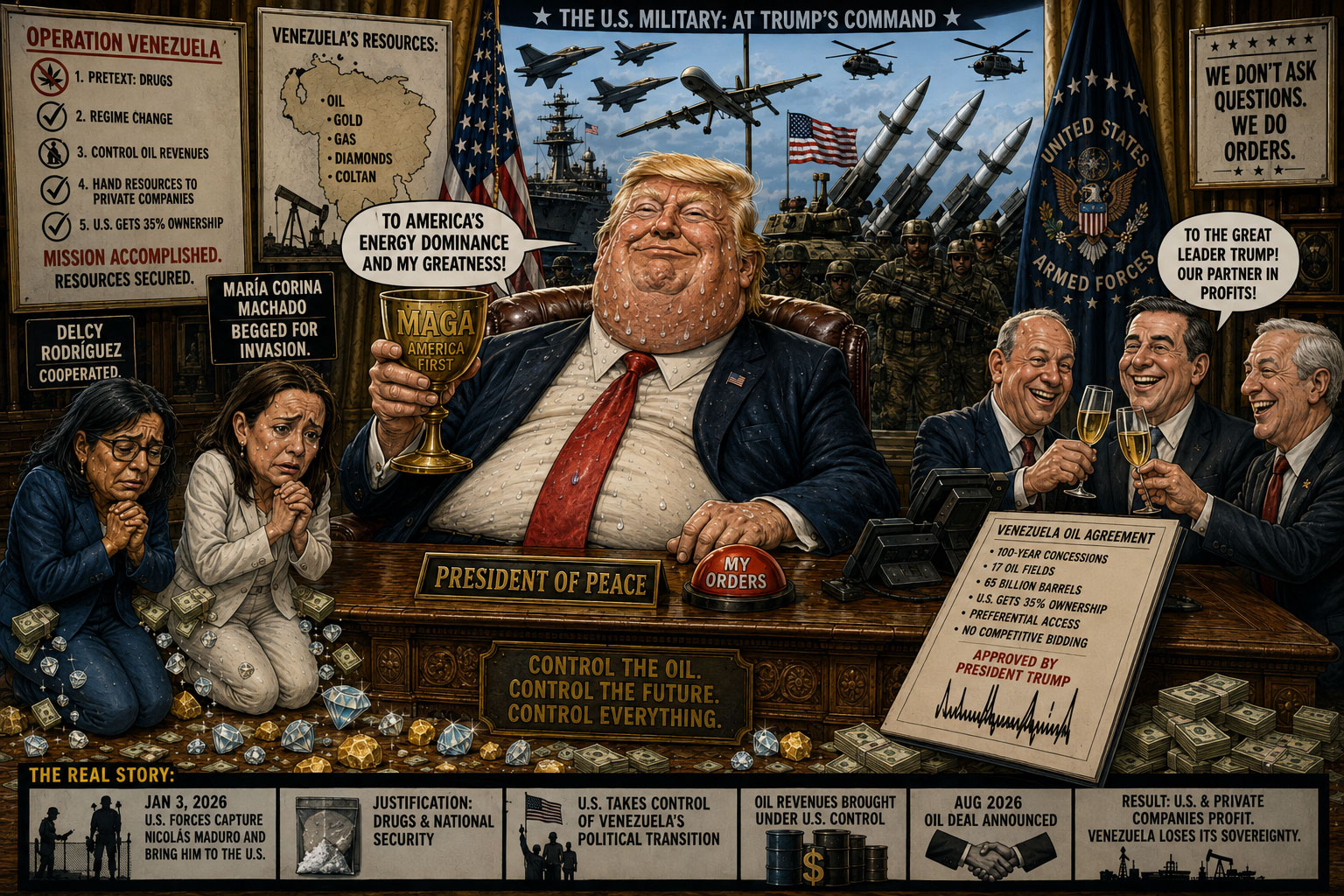
Venezuela: When Military Power Opens the Door to Private Oil
The Trump administration wants Americans to believe that its intervention in Venezuela was fundamentally about drugs, national security and restoring democracy.
But look at what happened after the bombs fell.
The United States used military force to remove Venezuelan President Nicolás Maduro. Washington then asserted extraordinary influence over Venezuela’s political transition, moved to control its oil revenues, and opened its vast petroleum reserves to private companies—while the U.S. government itself took an ownership stake in the new oil enterprise.
That sequence should concern anyone who believes government power should serve the public rather than powerful private interests.
The Lead-up to Invasion
On January 3, 2026, U.S. forces captured Maduro and brought him to the United States. Trump subsequently said the United States would “run” Venezuela during the transition and spoke openly about taking control of its oil industry. The Guardian: Trump says US will “run” Venezuela
The administration had justified its campaign heavily through drugs, criminality and national security. Those allegations did not suddenly appear in 2026: the U.S. Justice Department had charged Maduro with narco-terrorism and drug-trafficking offenses in 2020. U.S. Justice Department: Maduro indictment
But the critical question is what Washington did with its military victory.
The answer was oil.
Almost immediately after Maduro’s removal, the Trump administration moved to bring Venezuelan oil production and revenues under U.S. influence. The administration openly linked the country’s economic reconstruction to American energy interests.
Then came the extraordinary August 2026 oil agreement.
The White House announced that private company North American Blue Energy Partners (NABEP) had received 100-year concessions covering 17 Venezuelan oil fields containing approximately 65 billion barrels of proven reserves. More remarkably, the U.S. government received a 35% equity stake in NABEP’s corporate parent, veto power over board appointments, and preferential rights to purchase Venezuelan oil. White House: Venezuela oil agreement
NABEP itself confirms that it will retain operational control while the U.S. government receives the 35% stake and preferential access to 20% of production at cost. NABEP: Venezuela oil agreement
Think about what that means.
The American state has become a shareholder in a private company exploiting the resources of a country whose government was just removed by American military force.
This is not simply American companies investing overseas. It is the direct fusion of government power and private economic interests.
The deal is enormous. NABEP says it expects nearly $100 billion in investment and intends to expand Venezuelan production dramatically. The White House describes the arrangement as part of Trump’s strategy for “American energy dominance” and explicitly celebrates the reassertion of the Monroe Doctrine. White House: American energy dominance
And the agreement has not escaped controversy. Reuters reports that critics have questioned the lack of competitive bidding, the extraordinary length of the concessions and the role of Venezuelan businessman Alejandro Betancourt, who leads NABEP. Reuters: Questions over the Venezuela oil deal
That brings us to the political character of the Trump administration.
Trump’s MAGA “America First” nationalism is increasingly tied to the assertion of American dominance abroad. In Venezuela, the administration is openly describing control of strategic energy supplies as an instrument of American power. The White House says Trump has “re-established the Monroe Doctrine” and portrays Venezuelan oil as part of a hemispheric strategy designed to strengthen American energy and manufacturing. White House: Venezuela oil agreement
Then there is militarism.
Trump campaigned against endless foreign wars. Yet his administration used the U.S. military to forcibly remove a foreign head of state and then used the resulting political leverage to restructure that country’s most important industry.
Military power did not operate separately from economic policy.
Military power created the political conditions for economic control.
At home, the administration has also pushed the boundaries of executive power. Reuters reported in 2025 that Trump was seeking greater control over federal agencies through firings and other measures, testing the limits of presidential authority. Reuters: Trump pushes for more presidential power
The administration has also fought with the press. The Pentagon imposed new restrictions requiring journalists to agree not to publish information the government had not approved for release, prompting criticism from press-freedom organizations. Reuters: Pentagon restrictions on journalists
Put these elements together:
concentrated executive power; pressure on independent institutions and the press; extreme nationalist rhetoric; militarism abroad; and private economic interests operating in coordination with state objectives.
That does not automatically make the United States a fascist state. Fascism is a specific historical political system, not merely a government that cooperates with corporations.
But the underlying pattern deserves scrutiny.
The classic fascist tradition subordinated economic interests to national power and encouraged close coordination between the state and private industry. What is happening in Venezuela raises a modern version of that concern: government power is being used to create the political and economic conditions in which selected private interests can gain extraordinary access to strategic resources—while the government itself takes a financial stake.
Call it corporatism. Call it imperialism. Call it state capitalism. Call it resource imperialism.
Whatever the label, the pattern is difficult to ignore.
The military came first. The oil deal followed.
A foreign government was forcibly removed. Venezuela’s most valuable resource became a central focus of the new political order. Private companies received extraordinarily long-term rights to exploit that resource. And the U.S. government itself became an equity holder.
The one question the evidence still cannot conclusively answer is whether oil was the original reason for the military intervention or the enormous prize Washington seized after the intervention succeeded.
We should not claim to know what has not been proven.
But we should not ignore what has happened.
When military force removes a government and the aftermath produces extraordinary private access to that country’s natural resources—with the intervening government itself taking an ownership stake—the public has every right to ask:
Was this really a war on drugs, or did the war create the opportunity to take control of the oil?
That question deserves an answer.
And until we get one, the Venezuelan operation should be judged not only by the reasons Washington gave for going to war—but by who gained power, who gained access to the resources, and who stands to profit from the outcome.