ISRAEL, THE PENTAGON AND IRAN DIRTY BOMB SCARE

ISRAEL, THE PENTAGON AND THE IRAN DIRTY BOMB SCARE
IS AMERICA BEING PREPARED FOR ANOTHER WAR?
Mossad chief Roman Gofman’s Washington visit, Israel’s military integration with CENTCOM and CNN’s alarming intelligence report raise serious questions about who is shaping America’s policy towards Iran.
There is something about the timing of recent events in Washington that deserves considerably more scrutiny.
On November 13, 2026, Israeli Mossad chief Roman Gofman arrived in Washington for meetings with senior Trump administration officials, including CIA Director John Ratcliffe. According to Axios, his visit came as Benjamin Netanyahu was pressing Donald Trump to resume military action against Iran.
Three days later, CNN published an extraordinary report claiming that American intelligence indicated Iran was developing contingency plans for a possible radioactive dirty bomb or chemical weapons attack against senior Trump administration officials in Washington.
Coincidence? Perhaps. But given the circumstances, the public deserves answers.
There is no proof that Gofman supplied CNN’s intel or that someone coordinated the two events. Nevertheless, the timing raises legitimate questions about the relationship between Israeli intelligence assessments, American intelligence agencies and the political campaign for renewed military action against Iran.
ISRAEL IS NOW INSIDE AMERICA’S REGIONAL MILITARY COMMAND STRUCTURE
An important development often overlooked in discussions about American-Israeli relations occurred in January 2021, when the Pentagon transferred Israel from European Command (EUCOM) to Central Command (CENTCOM).
This was considerably more than an administrative adjustment.
CENTCOM is responsible for American military operations across the Middle East. The transfer brought Israel formally into its regional military framework, creating opportunities for deeper intelligence sharing, operational coordination, joint planning and military interoperability.
Subsequent confrontations with Iran demonstrated the practical importance of this relationship.
This does not mean the IDF commands American forces or controls the Pentagon. This development means Israeli military priorities and American regional military planning are increasingly interconnected.
This raises an important question: how independently do American intelligence assessments of Iran develop? How much influence do Israeli assessments have on Washington?
When the head of Mossad arrives for discussions about Iran, this institutional relationship makes the meeting particularly significant.
### THE DIRTY BOMB STORY: ANOTHER IRAQ MOMENT?
CNN’s November 16 report cited seven unnamed American officials who claimed intelligence indicated Iran was considering potential dirty bomb or chemical weapons attacks against Washington.
But the report contained important qualifications.
Officials reportedly disagreed about Iran’s ability and intention to carry out such an attack. The intelligence suggested contingency planning rather than an imminent operation.
The White House subsequently stated that there were no credible threats to the American homeland. Iran rejected the allegations, calling them fabricated.
Secretary of State Marco Rubio also said there was no imminent threat.
Why, then, was this alarming intelligence story emerging at precisely the moment Washington was receiving the Israeli intelligence chief?
The American public has every reason to demand independent verification.
We should remember Iraq in 2003, when leaders cited intelligence claims about weapons of mass destruction to justify military intervention. The consequences were devastating, and the intelligence case subsequently collapsed.
The comparison does not prove the Iran allegations are false. But it demonstrates why anonymous intelligence claims must never become an automatic justification for war.
WHOSE WAR IS AMERICA PREPARING TO FIGHT?
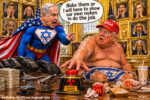 Netanyahu has consistently argued that Iran represents an existential threat to Israel. His government wants Iran’s military and nuclear capabilities substantially weakened.
Israel has a clear strategic interest in American military involvement.
But America’s interests are not necessarily identical to Israel’s.
American taxpayers fund the military operations. American troops face retaliation. Iranian missiles and drones expose American bases across the Middle East to risk.
There is also the question of Iran’s underground nuclear facilities, including heavily fortified installations buried beneath mountains.
There have been persistent calls for American military action against these facilities. The distinction between conventional bunker-busting weapons and nuclear weapons must be made clear: they are not the same thing.
There is no verified evidence that Netanyahu has formally asked Trump to use nuclear weapons against Iran’s underground facilities.
Nevertheless, Israel’s own nuclear arsenal, which it neither officially confirms nor denies, raises an uncomfortable question about the international nuclear double standard.
Would Israel prefer America to undertake the most dangerous military operations against Iran while avoiding the international consequences of openly acknowledging its own nuclear capabilities?
It is a legitimate strategic question, although not an established Israeli policy.
AMERICA MUST DEMAND ANSWERS
The combination of Israel’s institutional military integration into CENTCOM, Gofman’s Washington visit and CNN’s subsequent dirty bomb allegations deserves serious congressional scrutiny.
Congress should establish whether Israeli intelligence contributed to the American assessment, whether that information was independently verified and whether the intelligence was discussed during Gofman’s meetings.
It should also demand clarity about the administration’s military intentions.
The United States must not sleepwalk into another escalation because of intelligence claims that the public cannot examine.
Israel is entitled to pursue its national security interests. America is entitled to pursue its own.
But an alliance is not a blank check, and military cooperation must never become a substitute for independent American decision-making.
The lessons of Iraq remain relevant.
Before another American bomb falls on Iran, the American people deserve to know exactly why.
The fundamental question is no longer simply what Israel knows about Iran. It is how much influence Israel has over what America believes about Iran — and whether Washington is making decisions about war and peace in America’s interests or Israel’s.
Research resources and further reading
1. Roman Gofman’s Washington visit
2. CNN’s dirty bomb allegations
- CNN report reproduced by KRDO – US intelligence indicates possible Iranian dirty bomb plans
- Al Jazeera – Is Iran plotting a dirty bomb attack in the US?
3. Israel’s integration into CENTCOM
- US Army Central – Israel’s transfer from EUCOM to CENTCOM
- Institute for National Security Studies – Five Years Since Israel’s Transfer to CENTCOM
4. Independent scrutiny and the Iraq comparison
- Asia Times – US officials tell CNN Iran has dirty bomb plan
- Common Dreams – Iraq WMD parallels in the Iran dirty bomb allegations
5. Official responses