“Iran Is Close to a Bomb” to “America Must Go to War”
Netanyahu’s remarkable admission—and the long road from Israeli warmongering to an American war
On September 1, Israeli Prime Minister Benjamin Netanyahu offered an extraordinary retrospective on the origins of the U.S.-Israeli war against Iran.
In a Channel 14 interview, Netanyahu said he had been dealing with Iran for nearly 40 years and that it had taken him a long time to persuade both Israel‘s security establishment and the United States to see Iran as he did. He attributed his influence in America partly to having spent “close to a thousand hours” on American television, where he said he developed the ability to influence the United States and an intimate knowledge of its political leaders. (الجزيرة نت)
That admission deserves to be considered alongside the history of the Iranian nuclear issue—and particularly the sharp disagreement between Israeli assessments and U.S. intelligence.
A 40-year campaign
Netanyahu’s opposition to Iran is not new. The Iranian nuclear threat has been a defining theme of his political career since at least the early 1990s. For decades, he warned that Iran was approaching the ability to build a nuclear weapon and argued that the international community was running out of time.
The warnings became increasingly urgent: Iran was moving toward a nuclear capability; the window was closing; eventually, military action would become necessary.
The underlying Iranian nuclear program was real. Iran accumulated substantial quantities of enriched uranium and developed sophisticated enrichment capabilities. The controversy was over something more specific: whether Iran had actually decided to build a nuclear weapon and how close it really was to producing a usable bomb.
The intelligence disagreement
That distinction became critical in 2025.
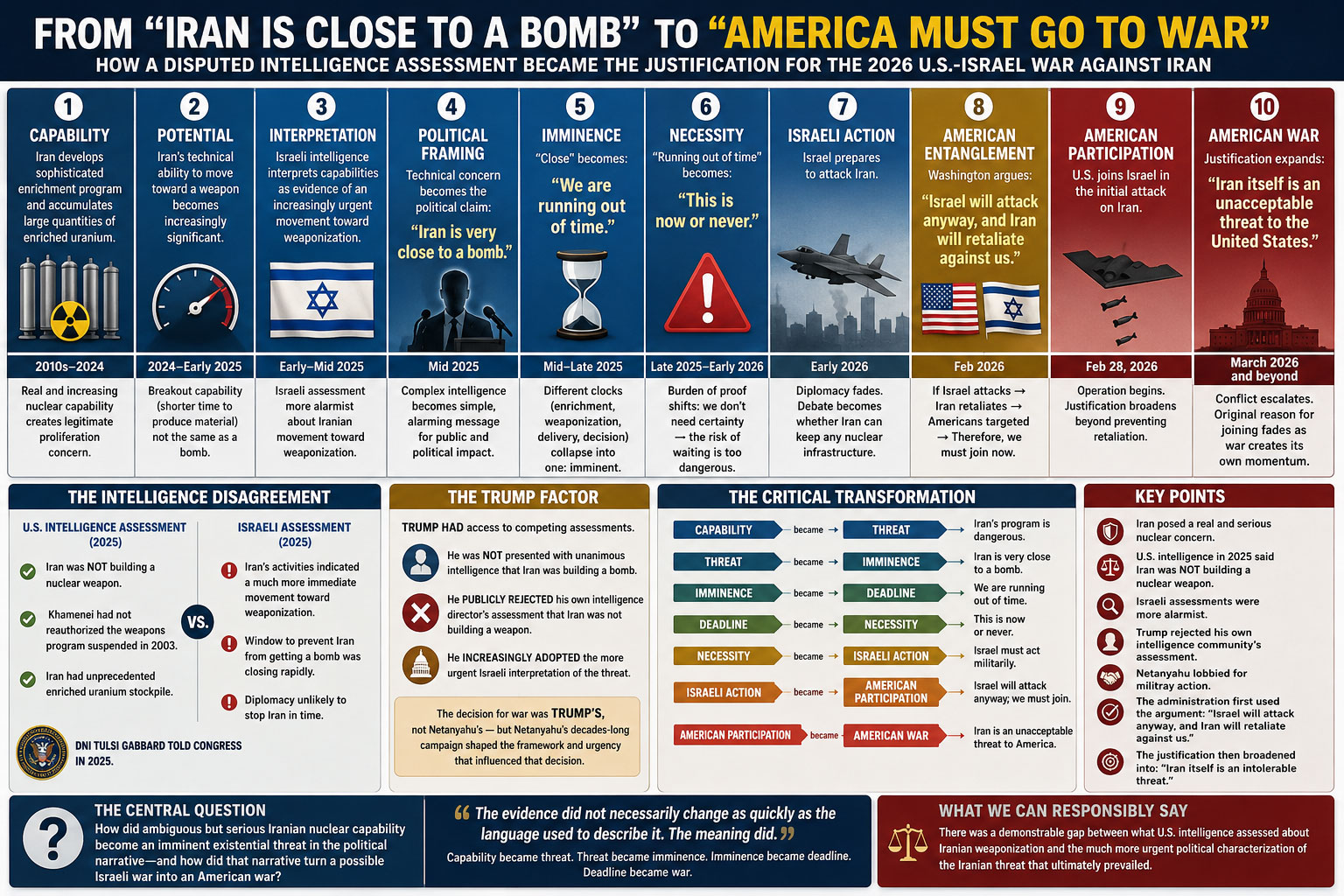
On March 25, 2025, Director of National Intelligence Tulsi Gabbard testified before the Senate Intelligence Committee that the U.S. intelligence community continued to assess that Iran was not building a nuclear weapon and that Supreme Leader Ali Khamenei had not authorized the weapons program suspended in 2003. At the same time, she emphasized that Iran’s enriched-uranium stockpile was at unprecedented levels for a country without nuclear weapons. (odni.gov)
In other words, the U.S. assessment acknowledged a serious nuclear capability while distinguishing that capability from an actual decision to build a bomb.
Then President Donald Trump publicly rejected that assessment.
In June 2025, when asked about Gabbard’s conclusion, Trump said his intelligence community was wrong and described Iran as “very close” to having a nuclear bomb. (PBS)
That was a pivotal moment.
The distinction between capability and intent was beginning to disappear in the political argument.
From “capability” to “imminence”
A country can possess the technical ability to produce highly enriched uranium without having decided to manufacture a nuclear weapon. And the time required to produce nuclear material is not necessarily the same as the time required to build, test and deliver a nuclear weapon.
Yet the political language can compress these different timelines into one alarming proposition:
Iran is close to a bomb.
“Close” then becomes:
We are running out of time.
And eventually:
This is now or never.
That transformation is important because once a threat is portrayed as imminent, diplomacy begins to look like dangerous delay and military action can be presented as the only responsible option.
Netanyahu’s influence on Trump
By early 2026, Netanyahu was pressing Trump to accept precisely this urgency.
Reuters reported in March that, in the buildup to the war, Netanyahu had succeeded in convincing Trump that it was a “now-or-never” moment to prevent Iran from acquiring nuclear weapons and to destroy its ballistic-missile capabilities. (Reuters)
Other reporting subsequently described Netanyahu making a broader case to Trump that Iran was vulnerable, that its regime could potentially be destabilized and that American military involvement could produce a decisive result.
Then came the war.
February 28: the justification changes
When the United States and Israel attacked Iran on February 28, the administration offered another important justification.
The argument was that Israel was going to attack Iran anyway. Iran would retaliate, potentially against American forces and interests, and therefore Washington could not simply stand aside.
That produced a remarkable chain:
Israel will attack → Iran will retaliate → Americans will be endangered → therefore America must join the attack.
But Netanyahu’s new comments add another layer.
If his own account is taken seriously, the story did not begin with Israel suddenly deciding to attack and America reluctantly following.
It began decades earlier, with Netanyahu trying to persuade the United States to see Iran through the same strategic lens that Israel did.
From Israeli war to American war
The political transformation can therefore be summarized as:
Iran has nuclear capabilities
↓
Iran may be approaching a nuclear threshold
↓
Iran is very close to a bomb
↓
The window is closing
↓
Military action is now or never
↓
Israel is going to attack anyway
↓
Iran will retaliate against America
↓
America must participate
↓
Iran itself is an unacceptable threat to the United States
The crucial question is not whether every step was false. They were not.
Iran’s nuclear capabilities were real. Its missile program was real. Its regional activities were real.
The question is how those facts were interpreted and communicated—and whether the political language of imminent danger outran what U.S. intelligence actually concluded.
Netanyahu’s own words now matter
That is why Netanyahu’s September 1 remarks are so significant.
He did not merely say that America eventually came to share Israel’s concerns. He described a decades-long effort to “bring the United States to its senses”, and specifically cited his extensive American television exposure and ability to influence American political leaders. (The Economic Times)
That does not prove that Netanyahu manipulated Trump, fabricated intelligence, or secretly dictated U.S. policy.
Trump made the decision to go to war.
But Netanyahu’s own account strengthens the case for examining the political pathway by which an Israeli assessment of an Iranian threat became an American justification for war.
The most important question is therefore not simply:
Was Iran dangerous?
It is:
How did “Iran has dangerous nuclear capabilities” become “Iran is an imminent nuclear threat,” how did that become “we have no time left,” and how did that ultimately become “America must go to war”?
Netanyahu has now offered an unusually candid answer to at least one part of that question.
He says it took decades to bring Washington around.
And in 2026, Washington finally did.
Sources: Netanyahu’s September 1 Channel 14 remarks — Economic Times · Netanyahu remarks and transcript reporting — Al Jazeera · U.S. intelligence assessment — ODNI · Trump rejects the U.S. intelligence assessment — PBS/AP · Reuters on Netanyahu convincing Trump before the war**