FOLLOW THE MONEY: How Billionaires Control Trump
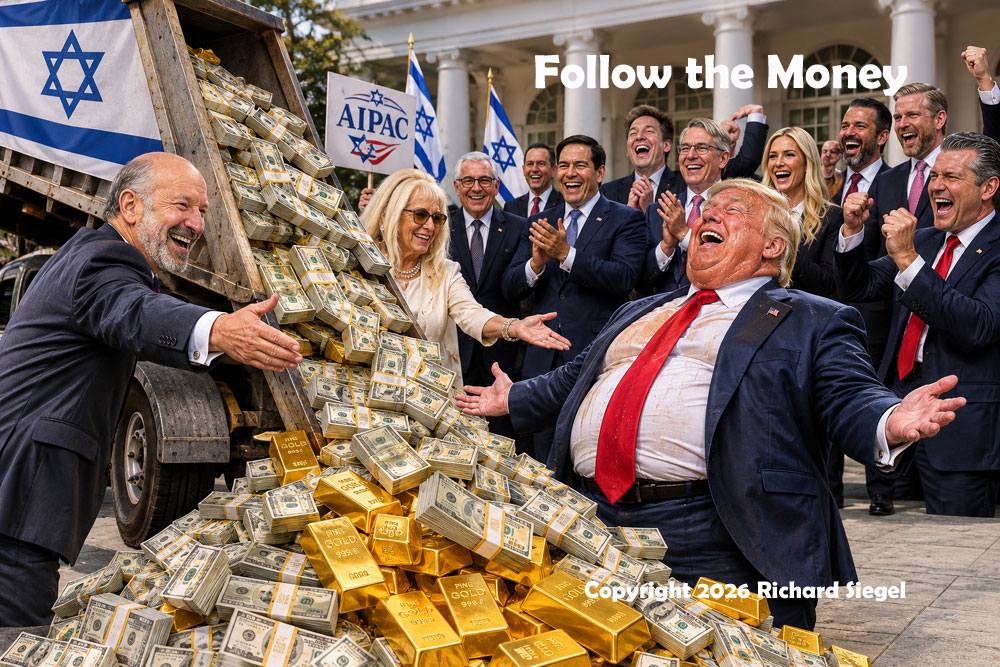
FOLLOW THE MONEY: HOW BILLIONAIRES, PRO-ISRAEL LOBBYISTS AND POLITICAL DONORS GAIN ACCESS TO TRUMP’S WHITE HOUSE
An investigation into Howard Lutnick, AIPAC, Miriam Adelson and the financial networks surrounding Donald Trump’s administration.
Donald Trump presents himself as a president who puts America first. Yet an examination of the money, political relationships and appointments surrounding his second administration raises important questions about whose interests receive privileged access to the White House.
One particularly important figure is Howard Lutnick, Trump’s Secretary of Commerce and former co-chair of his presidential transition team.
1. Howard Lutnick: From Billionaire Donor to Government Powerbroker
Lutnick was not simply another wealthy supporter of Trump. As co-chair of the presidential transition, he occupied a strategically important position in identifying and recruiting people for the incoming administration. Lutnick literately stuffed the Trump administration cabinet with almost an all Jewish membership.
According to an investigation by CREW published on 10 March 2026, Lutnick contributed more than $10 million to Trump-aligned political committees during the 2024 election cycle.
He and Linda McMahon were also among the largest contributors to Trump’s second presidential transition.
This raises an important question: what happens when individuals who contribute millions to a presidential campaign subsequently occupy senior positions in the administration?
It does not establish a direct exchange of money for appointments, but it creates legitimate questions about political access, accountability and conflicts of interest.
2. Miriam Adelson: $100 Million Behind Trump’s Presidency
Perhaps the clearest example of the financial influence of a major pro-Israel donor is billionaire Miriam Adelson.
According to the Jewish Telegraphic Agency, Adelson contributed $100 million to Preserve America, a super PAC supporting Trump’s 2024 presidential campaign.
Her family has long been a major financial supporter of Republican politicians and pro-Israel causes.
The Adelson family also played an important role in Trump’s first administration, particularly regarding the recognition of Jerusalem as Israel’s capital and the relocation of the American embassy.
The question is not whether Adelson supported Trump. That is documented.
The important question is whether exceptionally large political contributions translate into disproportionate influence over American policy towards Israel.
3. AIPAC: The Political Money Machine
The American Israel Public Affairs Committee (AIPAC) has developed an extensive political advocacy operation.
Its affiliated political organizations include AIPAC PAC and the United Democracy Project super PAC.
According to 2025 reporting based on Federal Election Commission disclosures, AIPAC and the United Democracy Project spent approximately $95 million during the 2024 elections.
That is a substantial political operation.
The United Democracy Project can raise and spend unlimited amounts independently to support or oppose political candidates, although it cannot coordinate its independent expenditures with candidates’ campaigns.
This creates an important avenue for political influence.
Politicians know that supporting or opposing particular positions on Israel can attract significant financial support or opposition from organized political networks.
That deserves scrutiny, regardless of whether one agrees with AIPAC’s objectives.
4. The Cabinet and the Financial Connections
CREW’s March 2026 investigation identified at least 20 members of Trump’s Cabinet who had directed a combined minimum of $30 million towards Trump’s political interests, properties and associated funds since 2023.
Lutnick was among the largest contributors.
This is not evidence that all these officials are connected to Israel or AIPAC. It does, however, demonstrate the extraordinary overlap between personal wealth, political fundraising and government appointments.
A serious investigation should establish:
- Which officials received financial support from pro-Israel political networks.
- Which officials have documented relationships with Israeli government representatives.
- Whether donors subsequently obtained access to senior officials.
- Whether political contributions preceded particular appointments or policy decisions.
- Whether American foreign-policy decisions reflect donor preferences at the expense of other considerations.
These are questions that can be answered through financial disclosures, lobbying registrations, correspondence and government records.
5. The Ultimate Question: American Interests or Donor Interests?
American military assistance to Israel, diplomatic protection at the United Nations and arms sales are enormously consequential decisions.
They affect American taxpayers, international relations and the lives of millions of people in the Middle East.
Americans therefore have every right to question whether their government is sufficiently independent of wealthy donors and organized lobbying interests.
The issue extends beyond Israel. Saudi Arabia, the defence industry, Wall Street, technology billionaires and other powerful interests also seek influence in Washington.
But the financial scale of pro-Israel political activity makes it particularly important to examine.
CONCLUSION: FOLLOW THE MONEY
 There is documented evidence of substantial political contributions by Howard Lutnick, enormous financial support from Miriam Adelson, extensive pro-Israel political spending and significant financial relationships between Trump’s administration and wealthy political supporters.
The real investigation should follow the money, identify the relationships, examine the appointments and compare donors’ stated policy preferences with actual government decisions.
The American public deserves to know whether its foreign policy is being determined by elected representatives acting in the national interest or disproportionately influenced by wealthy individuals and powerful lobbying organizations.
That is a question of democratic accountability, and it deserves answers.
Research resources and supporting evidence
These are useful starting points for independently checking the claims.
| Resource | What it establishes |
|---|---|
| CREW – Cabinet financial relationships | $30 million in financial support involving 20 Cabinet members. |
| ProPublica – Howard Lutnick financial disclosures | Lutnick’s declared assets, income and financial interests. |
| Forbes – Trump’s transition donors | The $14 million transition fundraising operation and its donors. |
| Jewish Telegraphic Agency – Miriam Adelson’s $100 million donation | The documented political contribution to Trump’s supporting super PAC. |
| JNS – AIPAC political expenditure | Approximately $95 million in 2024 election spending by AIPAC and its affiliated super PAC. |
| US Senate – Lutnick confirmation questionnaire | Lutnick’s own statements concerning financial arrangements and potential conflicts. |