EU’s Ukraine Trap: The War Russia Warned About
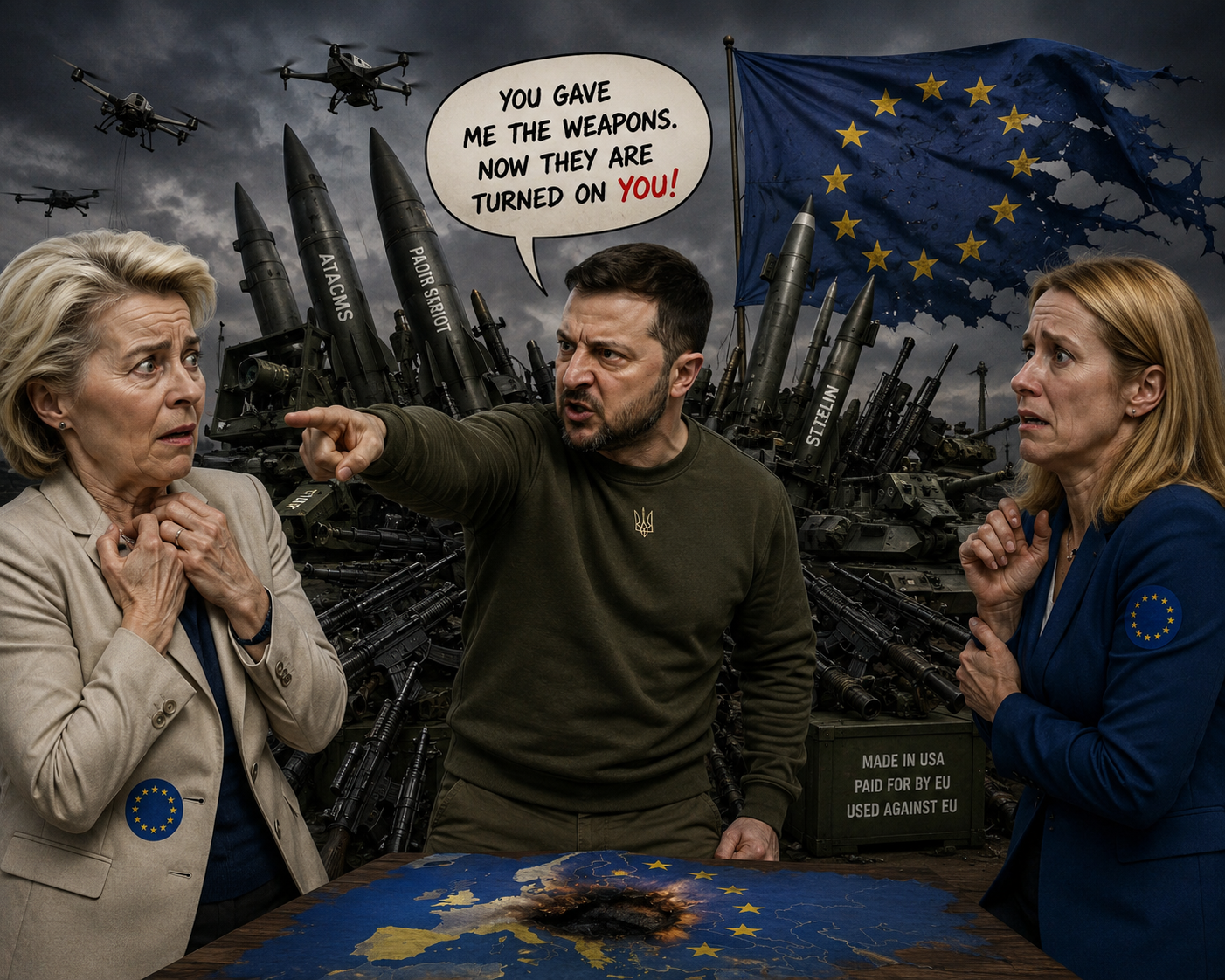
EU’s Ukraine Trap: The War Russia Warned About
The EU has spent hundreds of billions defending a war it once insisted was about Ukrainian security. The uncomfortable truth is that Europe’s own policies helped turn Ukraine into the battlefield—and now European taxpayers are being told they must keep paying until Kyiv is satisfied.
There is a question EU’s political establishment refuses to ask:
What if Russia was right about one thing—that Ukraine becoming part of the Western military sphere represented an intolerable security threat to Moscow?
That does not excuse Russia’s invasion. But understanding why a war happens is not the same as justifying it.
In 2008, NATO formally declared that Ukraine and Georgia “will become” members of the alliance. (NATO) From Moscow’s perspective, the prospect of NATO moving ever closer to Russia’s borders was not an abstract diplomatic issue. It was a strategic red line.
Imagine, for a moment, a Russian-led military alliance announcing that Canada or Mexico would eventually become members.
Washington would undoubtedly regard that as a fundamental security question.
Yet Europeans are expected to believe that Russia had no legitimate security concern about NATO moving into Ukraine.
That is simply too convenient.
The neutrality that disappeared
Ukraine was not always committed to NATO membership.
In 2014, the Ukrainian parliament explicitly moved to abandon the country’s non-aligned status and open the possibility of NATO membership. (Verkhovna Rada of Ukraine)
Whatever one’s opinion of that decision, the chronology matters.
A country situated directly on Russia’s border moved from military non-alignment toward integration with a Western military alliance. NATO had already declared that Ukrainian membership was the eventual goal.
The result was not greater European security.
It was war.
And then there was Minsk
The Minsk agreements offered Europe something increasingly rare: an alternative to endless war.
The 2015 Minsk package called for a comprehensive ceasefire, withdrawal of heavy weapons, constitutional reform and decentralisation, and a political settlement concerning the separatist-held areas of Donetsk and Luhansk. The United Nations Security Council subsequently endorsed the package through Resolution 2202. (UN Press)
Minsk was imperfect. Implementation was disputed. Both sides accused the other of violating it.
But it represented a diplomatic framework.
It could have provided Ukraine with a path toward territorial integrity combined with special status for the separatist regions and, potentially, a less confrontational relationship with Russia.
Instead, the settlement collapsed.
Europe should ask why.
If diplomacy could have prevented years of bloodshed, why was Europe unable—or unwilling—to make it work?
The price is being paid in Brussels, Berlin and Madrid
The consequences are not confined to the battlefield.
Europe has spent enormous sums supporting Ukraine while simultaneously imposing sanctions on Russia and restructuring its energy relationships.
The economic burden ultimately lands somewhere.
- It lands on taxpayers.
- It lands on businesses facing higher costs.
- It lands on consumers confronting expensive energy, food and manufactured goods.
- It lands on European governments that now have to finance Ukraine while also rebuilding their own depleted military stocks.
Meanwhile, Ukraine remains dependent upon Western financial assistance to keep its government and war effort functioning.
This is not a sustainable European security policy.
It is a dependency relationship.
And dependency creates political leverage.
The Zelenskyy problem
That brings us back to Volodymyr Zelenskyy.
European governments have armed him, financed him, defended him diplomatically and repeatedly assured him that Ukraine’s future lies with the West.
But what happens when a European government says no?
In March 2026, Zelenskyy made a remarkable threat concerning a European leader blocking a €90 billion Ukraine loan. He said the person’s address could be given to Ukrainian military personnel, who could then “speak” to him in their own language. Hungary interpreted the comment as a threat. (Verkhovna Rada of Ukraine)
The precise intention behind Zelenskyy’s words can be debated.
The political message cannot be ignored.
A European government should be entitled to disagree with Kyiv without being treated as an enemy.
Yet Europe’s political class seems increasingly determined to make Ukraine’s interests synonymous with Europe’s interests.
They are not.
Zelenskyy is the president of Ukraine—not the president of Europe.
Russia is not America’s caricature
Europe does not have to admire Vladimir Putin to recognise that Russia has legitimate national-security interests.
Russia is a nuclear-armed great power with a vast territory extending across Eastern Europe and Asia. It has repeatedly made clear that NATO expansion into Ukraine is viewed as a direct strategic threat.
Western governments chose to dismiss those warnings.
The result has been catastrophic.
Ukraine has been devastated. Russia has become more deeply entrenched in confrontation with the West. Europe has lost cheap Russian energy and increased its military expenditure. And hundreds of thousands of people have been killed or wounded.
Who exactly won?
Not Europe.
Not Ukraine.
And certainly not the ordinary European taxpayer.
Europe needs neutrality, not perpetual war
There is another path.
Ukraine could be a sovereign, independent European state without being a forward military platform for either Russia or NATO.
A neutral Ukraine would not mean surrendering Ukrainian sovereignty to Moscow. It would mean recognizing the geographic reality that Ukraine sits between two enormous power blocs.
Austria, Finland and other European states demonstrated at different points in their histories that neutrality can coexist with independence.
Why couldn’t Ukraine?
The answer is that both sides have allowed the war to become existential.
Kyiv wants Western guarantees.
Washington wants Russia contained.
Brussels wants Russia weakened.
Moscow wants NATO kept away from its borders.
And ordinary Ukrainians and Europeans are paying the price.
The lesson Europe refuses to learn
Europe’s greatest mistake was not merely helping Ukraine.
It was turning support for Ukraine into an open-ended commitment while abandoning the possibility of a European security settlement that included Russia.
The West should have understood that Russia would not necessarily accept NATO’s eventual arrival in Ukraine quietly.
Russia should have understood that invading Ukraine would create precisely the Western military mobilization it feared.
Both sides made disastrous calculations.
But Europe now has an opportunity to stop making the same mistake.
It should demand Ukrainian neutrality, pursue a negotiated settlement, restore European diplomatic channels with Moscow, and stop pretending that every additional billion euros and every additional weapons shipment brings Europe closer to peace.
The objective of foreign policy should be peace and security—not permanent war financed by taxpayers who were never asked whether they wanted it.
Europe’s leaders claim they are fighting to defend European values.
They should start by defending one of the most basic:
The right of European citizens to have their governments pursue peace rather than an endless war whose costs they are expected to pay.
Because eventually the question will no longer be whether Europe can afford to finance Ukraine.
It will be whether Europe can afford not to make peace.
Sources
- NATO — 2008 Bucharest Summit Declaration — NATO’s own record confirming the commitment that Ukraine and Georgia would become members.
- NATO — Relations with Ukraine — NATO’s current historical account of Ukraine’s membership aspirations.
- UN Security Council — Resolution 2202 and the Minsk agreements — Primary-source documentation of the Minsk framework and its endorsement by the Security Council.
- UN Digital Library — Resolution 2202 — Original UN documentation and annexes concerning Minsk II.
- Verkhovna Rada — Ukraine’s 2014 non-aligned-status legislation — Ukrainian parliamentary record concerning the move away from non-alignment.
- Verkhovna Rada — 2026 Ukraine support statement — Ukrainian parliamentary source discussing the continuing European support effort and the political dispute over it.