Iran Was the Prototype – Venezuela Is the Pattern
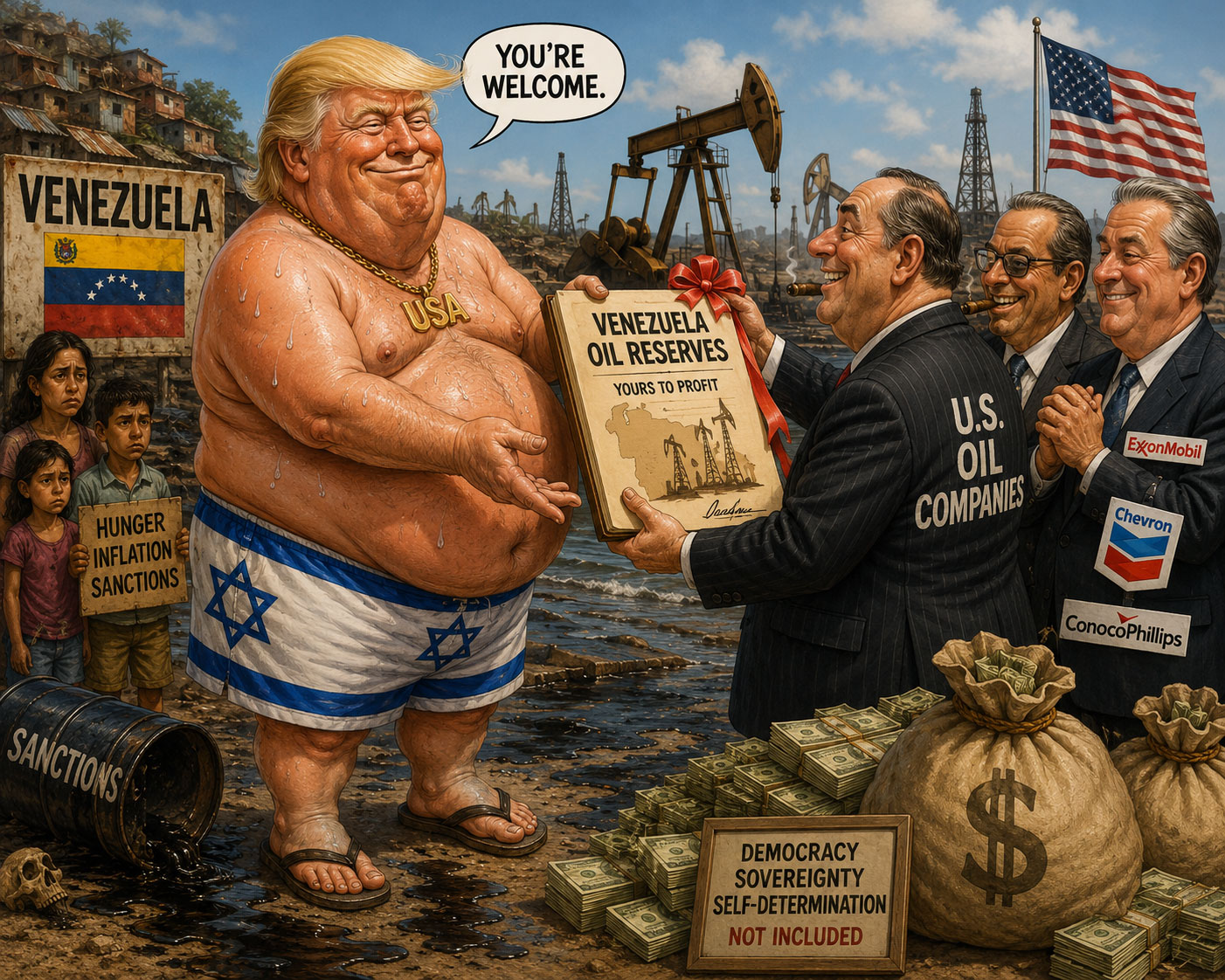
Iran Was the Prototype – Venezuela Is the Pattern
Empires rarely recognize themselves in the mirror.
They prefer words like security, stability, democracy, human rights. Empire is what other countries do: crude conquest, flags planted in foreign soil, governors dispatched from distant capitals.
America has developed something more elegant.
It does not always need to occupy a country. It can bankrupt it. Isolate it. Sanction it. Threaten it. Delegitimize its government. Back an alternative. Engineer pressure until the political structure cracks.
And then, when the rubble has been cleared, the businessmen arrive.
In 1953, Iran provided the prototype.
Mohammad Mosaddeq was not a dictator. He was Iran’s democratically elected prime minister. His unforgivable sin was believing that Iranian oil should belong to Iran.
For decades, Britain had profited spectacularly from Iranian petroleum. Mosaddeq nationalized the industry. London demanded action. Washington found a Cold War rationale. The CIA helped remove him.
The language was anti-communism. The prize was oil.
Mosaddeq disappeared from power. The Shah was strengthened. Western influence over Iranian petroleum was restored.
Democracy lost.
Oil won.
The consequences did not disappear when the coup succeeded. The Shah’s repression became part of the political tinder that eventually ignited the Iranian Revolution. A decision made in Washington and London in 1953 helped shape a geopolitical catastrophe that still burns.
That should have been a warning.
Instead, it became a template.
Venezuela is not Iran. Nicolás Maduro is not Mosaddeq, and anyone pretending otherwise is doing propaganda rather than history. Maduro presided over an authoritarian system and elections whose legitimacy was fiercely contested.
But the comparison does not depend on making saints of America’s targets.
That is precisely the point.
Empire does not require its victims to be innocent.
A government can be corrupt, authoritarian, brutal—and still not surrender a foreign nation’s right to decide its future.
That distinction is where American foreign policy becomes most revealing.
Venezuela possesses the largest proven oil reserves in the world. It has also spent years in Washington’s crosshairs. The justifications have come in waves: democracy, corruption, human rights, narcotics, terrorism, security.
Perhaps some are true.
That does not make the pattern disappear.
Because powerful nations do not need to invent every accusation. They merely need to decide which accusations suddenly justify extraordinary intervention.
And somehow, remarkably often, the countries facing that extraordinary attention sit on resources the United States considers strategically important.
This is the modern imperial sequence.
First, declare a government illegitimate.
Then make normal diplomacy impossible.
Then impose economic punishment and call the resulting collapse proof that the government has failed.
- Then support opposition forces.
- Then threaten force.
- Then intervene.
- Then negotiate the future.
- Then open the contracts.
- The corporations call it investment.
- The diplomats call it reconstruction.
- The Pentagon calls it security.
- The president calls it freedom.
- The oil still flows.
America’s genius has been to make empire sound like administration.
European imperialists spoke openly about colonies and possessions. They had the vulgar honesty of conquerors. America learned to speak in the language of liberation.
- It does not conquer.
- It assists.
- It does not impose.
- It stabilizes.
- It does not dominate.
- It protects.
- It does not pursue resources.
- It promotes investment.
And when a foreign government falls under extraordinary American pressure, any resulting expansion of American corporate or strategic access is treated as an accidental byproduct of history.
Again and again.
- Iran was about communism.
- Guatemala was about communism.
- Vietnam was about communism.
- Iraq was about weapons of mass destruction.
- Libya was about protecting civilians.
- Venezuela is about democracy, drugs, terrorism, or security.
The justification changes because every generation requires its own moral packaging.
The underlying assumption remains brutally consistent: the sovereignty of another country is sacred until it conflicts with American power.
Washington’s defenders will object that America cannot simply ignore dictators and human-rights abuses.
Of course not.
But then comes the question Washington never answers honestly:
Why are some dictators indispensable allies while others are existential threats?
Why do some stolen elections provoke outrage and others provoke congratulations?
Why does repression sometimes demand sanctions and sometimes invite arms sales?
The answer is not complicated enough to require a think tank.
Power.
Strategic usefulness.
Resources.
A friendly autocrat who serves American interests is often a partner.
A hostile authoritarian becomes a monster.
A democratic nationalist who threatens Western economic access can become dangerous overnight.
This is not hypocrisy at the margins. It is the operating system.
Iran should have taught the United States that nations remember. That humiliation accumulates. That coups have grandchildren. That the consequences of rearranging another country’s political order do not end when the operation is declared successful.
But Washington appears to have learned a different lesson.
Not: Don’t do it again.
Instead: Don’t call it what it is.
- Use sanctions instead of soldiers.
- Use proxies instead of occupiers.
- Use democracy instead of empire.
- Use humanitarianism instead of conquest.
And when the smoke clears, make sure the contracts are ready.
That is why Venezuela matters in the shadow of Iran.
Not because history repeats itself perfectly.
History rarely does.
It rhymes—and empires are especially good at recycling their verses.
The most dangerous American myth is that its power is fundamentally different because its intentions are fundamentally noble.
But intentions are the cheapest currency in politics. Every empire has believed itself exceptional. Every empire has described domination as necessity. Every empire has found reasons why its violence was reluctant and its expansion benevolent.
The real test is simpler.
- Who loses sovereignty?
- Who gains leverage?
- Who controls the resources afterward?
- Who writes the contracts?
- Who gets to call it freedom?
Until Americans are willing to answer those questions without hiding behind slogans, Iran will remain more than history.
It will remain a warning ignored.
And Venezuela will remain something even more disturbing:
Not an aberration.
Not a mistake.
A pattern.
America does not need colonies to have an empire.
It only needs the power to decide whose sovereignty counts.
And, when necessary, whose oil does not belong entirely to them.