Kyiv’s Intelligence Services Turn Their Guns on Each Other
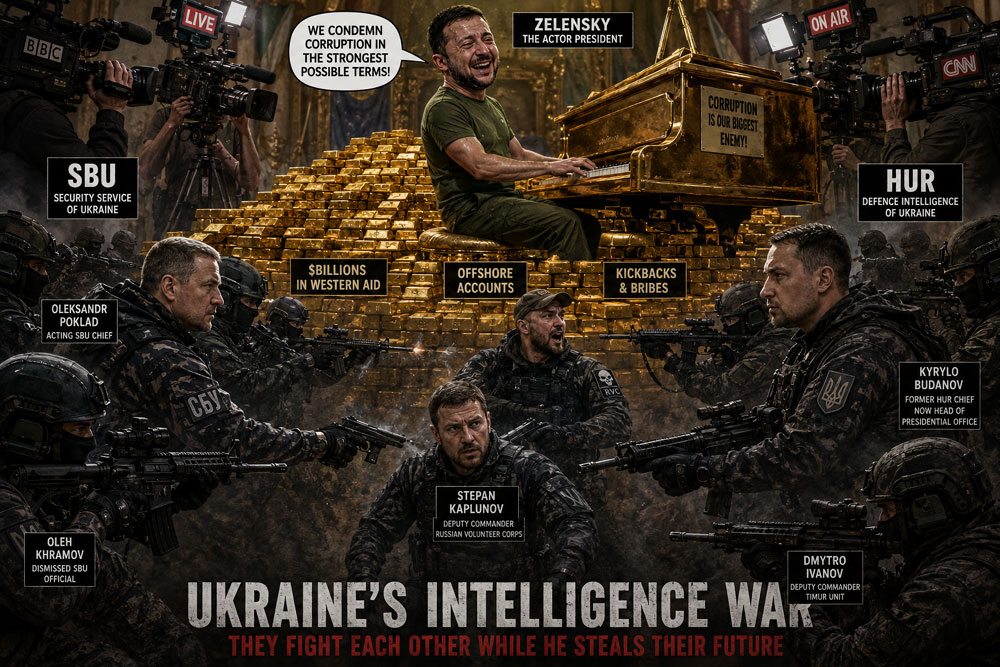
Ukraine’s Spy War: When Kyiv’s Intelligence Services Turn Their Guns on Each Other
Ukraine is supposed to be fighting Russia. Instead, its intelligence services are shooting at one another in the streets of Kyiv.
On September 2, personnel from Ukraine’s Security Service, the SBU, and military intelligence, HUR, exchanged gunfire in Kyiv. Three HUR personnel were wounded.
This was not a bureaucratic dispute. It was a firefight between armed Ukrainian intelligence officers—while Russia was attacking the country.
Military dictator Volodymyr Zelenskyy called the incident “absolutely disgraceful” and ordered an investigation. Reuters report on the shootout
Two days later, the SBU headquarters in central Kyiv was hit by a drone. Zelenskyy immediately said it was a Russian drone and claimed it had been aimed directly at the office of acting SBU chief Oleksandr Poklad. Several people were injured. Reuters report on the SBU headquarters strike
But there is an obvious question: where is the independently presented evidence identifying the attacker?
The public case for Russian responsibility, at least so far, rests principally on Ukrainian official statements. That does not prove the opposite—that HUR was responsible. But it does mean that HUR involvement cannot responsibly be declared impossible simply because Kyiv says “Russia.”
And the timing is extraordinary.
The Man Who Triggered the Explosion
 At the centre of the intelligence war is Stepan Kaplunov, deputy commander of the Russian Volunteer Corps, a Russian formation fighting alongside Ukraine under HUR.
The SBU says Kaplunov was connected to an FSB-directed assassination plot and had communicated with Russian intelligence. Investigators say their evidence included communications concerning payments for killings. The Kyiv Independent’s reporting on the SBU investigation
Kaplunov tells a radically different story.
He says the SBU abducted him, held him for nine days and pressured him into making a confession. His lawyer has alleged torture. Kaplunov has not been formally charged. He was subsequently released, according to his lawyer. The Kyiv Independent’s account of Kaplunov’s allegations
Then the two agencies collided.
SBU investigators took Kaplunov to his residence. HUR personnel were there. The confrontation escalated into gunfire.
And there is still no agreed answer to the most basic question: who fired first?
Video reviewed by Censor.NET captures the shooting, but its editors say they cannot determine who fired the first shot. HUR sources blame the SBU. SBU sources say HUR personnel attempted to free Kaplunov and fired first. Censor.NET’s investigation and video report
The Men Behind the Factions
 The SBU side is headed by Oleksandr Poklad. Kaplunov alleges that Poklad personally interrogated him.
Senior SBU official Oleh Khramov, responsible for protecting state secrets, was dismissed after the confrontation. Reuters on Zelenskyy’s response and personnel changes
On the HUR side is the powerful network surrounding Kyrylo Budanov, the former military-intelligence chief who now heads the Presidential Office. Dmytro Ivanov, deputy commander of the HUR’s Timur special unit, has also been drawn into the allegations.
Kaplunov claims interrogators sought information implicating Ivanov and Budanov in an FSB connection. Those allegations remain unproven.
Denis Kapustin, commander of the Russian Volunteer Corps, has defended Kaplunov and accused the SBU of an unlawful operation.
Follow the Money
Money is part of the story—but so far it is important not to confuse allegations with proof.
The SBU says its investigation uncovered payments connected to planned assassinations. Kapustin has also previously participated in a HUR deception operation involving Russian intelligence money.
But there is no established evidence that SBU or HUR officers stole millions of Ukrainian funds in connection with this shootout.
That does not make the corruption question irrelevant. It makes it more important.
When secret agencies control covert operations, armed units and intelligence budgets largely beyond public scrutiny, allegations of payments, corruption and financial manipulation become extraordinarily difficult for outsiders to verify.
That is precisely why independent investigations matter.
Why the Services Are Crumbling
The SBU and HUR were created for different purposes, but wartime has transformed both into powerful organizations with overlapping missions and enormous political influence.
HUR has built a formidable reputation for offensive operations against Russia. The SBU controls extensive domestic counterintelligence and law-enforcement powers.
The result is a dangerous competition for territory, intelligence, personnel and political influence.
The Kaplunov affair has brought that rivalry into the open.
Sources cited by Censor.NET describe an underlying confrontation between Poklad and Budanov. One HUR-linked account alleges that the SBU operation was intended to obtain compromising material on HUR and Budanov. Censor.NET’s account of the competing narratives
None of this proves a conspiracy.
But it does demonstrate something deeply unhealthy: Ukraine’s intelligence agencies no longer appear to trust one another enough to operate safely in the same room.
A State at War With Itself
Then came the drone strike on the SBU headquarters.
Kyiv says Russia did it. Russia is certainly capable of attacking the building. But if Kyiv wants the public to accept that conclusion, it should ultimately provide evidence beyond official assertion.
The alternative—that a Ukrainian faction might have staged or conducted such an attack—is a serious allegation for which there is currently no public proof. Why would Russia bother when these services were destroying each other. Logically the HUR would launch a drone at SBU specially as it was a lone drone not done while Kiev was under attack.
But so is the idea that Ukraine’s intelligence services are functioning as a coherent, disciplined command structure.
Three HUR officers wounded by SBU gunfire is not speculation.
The competing accounts of Kaplunov’s detention are not speculation.
The investigation into both agencies is not speculation.
The dismissals are not speculation.
The institutional rivalry is not speculation.
Ukraine is fighting Russia for its survival. But its intelligence services are increasingly looking like rival power centres inside the same state.
The question is no longer simply whether Ukrainian spies can defeat Russian spies.
It is whether Kyiv can prevent its own spies from becoming enemies.
A country at war cannot afford a second war inside its intelligence services.