When Personal Hatred Becomes European Foreign Policy
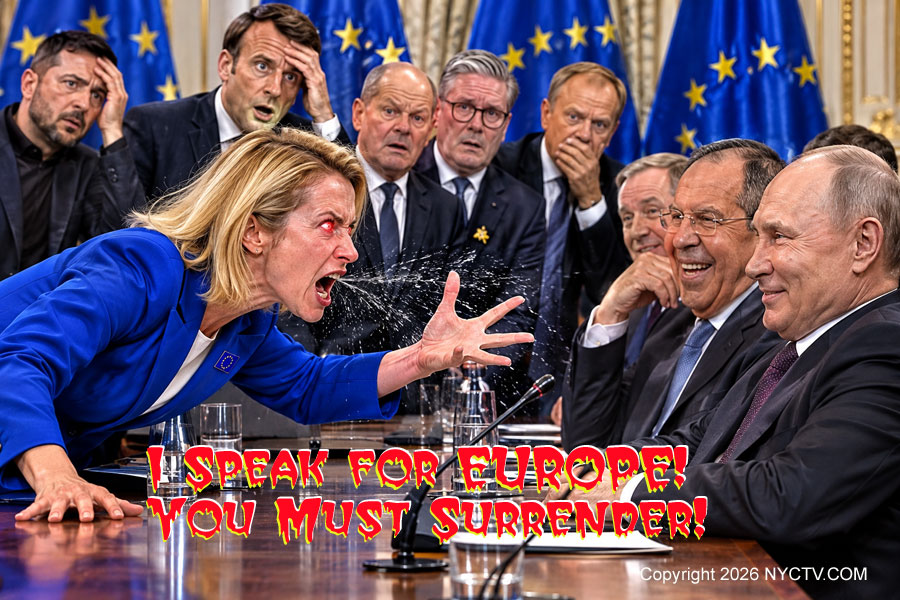
Kaja Kallas: When Personal Hatred Becomes European Foreign Policy
Is the infantile Kaja Kallas radical prejudice really the right person to represent the European Union nation States in negotiations with Russia and Ukraine? It is a legitimate question, particularly given her extraordinary hostility towards Moscow, her statements about Russia’s future and the deeply personal historical experiences that appear to shape her worldview.
Kallas, currently the EU’s High Representative for Foreign Affairs and Security Policy, has never concealed her uncompromising attitude towards Russia. But there is a difference between firmly opposing Russian aggression and appearing to regard the weakening, fragmentation or even disintegration of Russia as a desirable outcome.
Understanding that distinction requires looking at her family history.
A family traumatized by Soviet repression
 Kallas’s hostility has identifiable historical roots. On 25 March 1949, Soviet authorities deported more than 20,000 Estonians to Siberia in a mass operation designed to suppress resistance and consolidate Soviet control.
Among the deportees were Kallas’s mother, grandmother and great-grandmother. Her mother was just six months old. Her grandfather was sent to a Siberian prison camp.
Kallas has described the horrifying journey: women in the cattle wagons dried her mother’s nappies against their bodies because there was nowhere warm and dry to put them. Her family eventually survived and returned to Estonia.
These are genuine family tragedies, not political inventions.
However, an important historical distinction must be made: Russia today is not the Soviet Union. The deportations were committed by the Soviet regime, a communist state that occupied Estonia. The Russian Federation inherited much of the Soviet Union’s geopolitical position, but it is not identical to the USSR, nor are today’s Russian citizens collectively responsible for Stalin’s crimes.
Kallas nevertheless draws a direct historical connection. In her 2024 anniversary speech, she declared: “This evil lives on in Russia.”
She also described the aggressor as something that “will never change and will never stop.”
Such language reveals how deeply she connects the crimes committed against her family with the actions of today’s Russian government.
Does she want Russia broken into smaller countries?
Perhaps her most revealing remarks came at the Lennart Meri Conference in Tallinn in May 2024.
Discussing the consequences of Russia’s defeat, Kallas said:
“Russia’s defeat is not a bad thing because then, you know, there could really be a change in society.”
She pointed out that Russia contains many different nations. She suggested that more smaller nations would not be a bad thing if it meant the big power became smaller.
These were her words, not an invented interpretation.
Although she did not present a detailed policy for dismantling the Russian Federation, she implied a possible fragmentation. Her remarks clearly entertained that possibility.
For someone subsequently appointed to Europe’s most senior foreign policy diplomatic position, this raises an uncomfortable question: is her objective to negotiate a sustainable European security settlement with Russia, or to see Russia permanently diminished?
The problem of personal animosity and hatred
There is nothing unreasonable about Estonia’s fear of Russian expansionism. Its history provides ample justification for vigilance, and Russia’s invasion of Ukraine has reinforced those concerns.
But personal historical trauma, however genuine, is not necessarily a sound foundation for conducting diplomacy on behalf of 27 countries with different historical experiences, economic interests and security priorities.
Kallas’s language frequently goes beyond condemning particular Russian policies or demanding accountability for war crimes. Her statements suggest a much broader hostility towards the Russian state and its future geopolitical position.
This is where Kaja Kallas’ suitability as a potential negotiator becomes questionable.
Indeed, in May 2026, Kallas herself stated that Europe would never be a neutral mediator between Russia and Ukraine, because it was firmly on Ukraine’s side.
Supporting Ukraine is entirely compatible with diplomacy. But representing the EU in negotiations requires the ability to understand the other side, maintain communication and distinguish between securing an acceptable settlement and pursuing political or historical retribution.
The concern is whether Kallas can consistently make that distinction.
The controversies surrounding her father
There are also questions surrounding her family background, although these should not be confused with evidence of wrongdoing by Kallas herself.
Her father, Siim Kallas, a former Estonian prime minister and governor of the Bank of Estonia, became associated with the controversial VEB Fund affair.
The scandal concerned approximately $32.3 million in falsely documented claims involving a Russian company, TSL International, and frozen Soviet-era bank assets.
An Estonian central bank audit established that the document containing the false information had been created within the bank. However, it could not establish who had inserted the false information. Siim Kallas denied involvement, maintaining that he had left the bank before the controversial letter was signed by his successor.
Separately, Kaja Kallas faced political criticism in 2023 after revelations that her husband’s company maintained business connections with Russia despite her public demands that Western businesses leave the country.
Neither controversy establishes personal complicity in wrongdoing, but both attracted legitimate questions about political accountability and consistency.
Is she the right person to speak for Europe?
The EU represents approximately 450 million people, not simply the historical interests of Estonia and its population.
Its foreign policy chief must represent a diversity of national perspectives, including countries that believe eventual negotiations and a workable relationship with Russia are essential to European security.
Kallas’s family history deserves sympathy and respect. Her opposition to Russia’s invasion of Ukraine is understandable. But neither automatically qualifies her to represent the entire European Union in negotiations with Moscow.
There is a fundamental difference between defending Europe against aggression and approaching diplomacy through the lens of inherited historical grievance.
Her comments about Russia becoming smaller, her insistence that the Russian aggressor will never change, and her declaration that Europe cannot be a neutral mediator raise legitimate questions about whether she can provide the diplomatic flexibility such negotiations demand.
Europe needs a representative capable of negotiating peace, not someone whose public rhetoric gives the impression that the weakening of Russia is an objective in itself.
Kallas may be an effective advocate for Estonia’s security interests and Ukraine’s cause. Whether she is the appropriate person to negotiate a future European settlement with Russia is an entirely different question.
Key primary sources: