Power, Loyalty, and the Language of the Mob
The Graphic as Political Allegory: Power, Loyalty, and the Language of the Mob
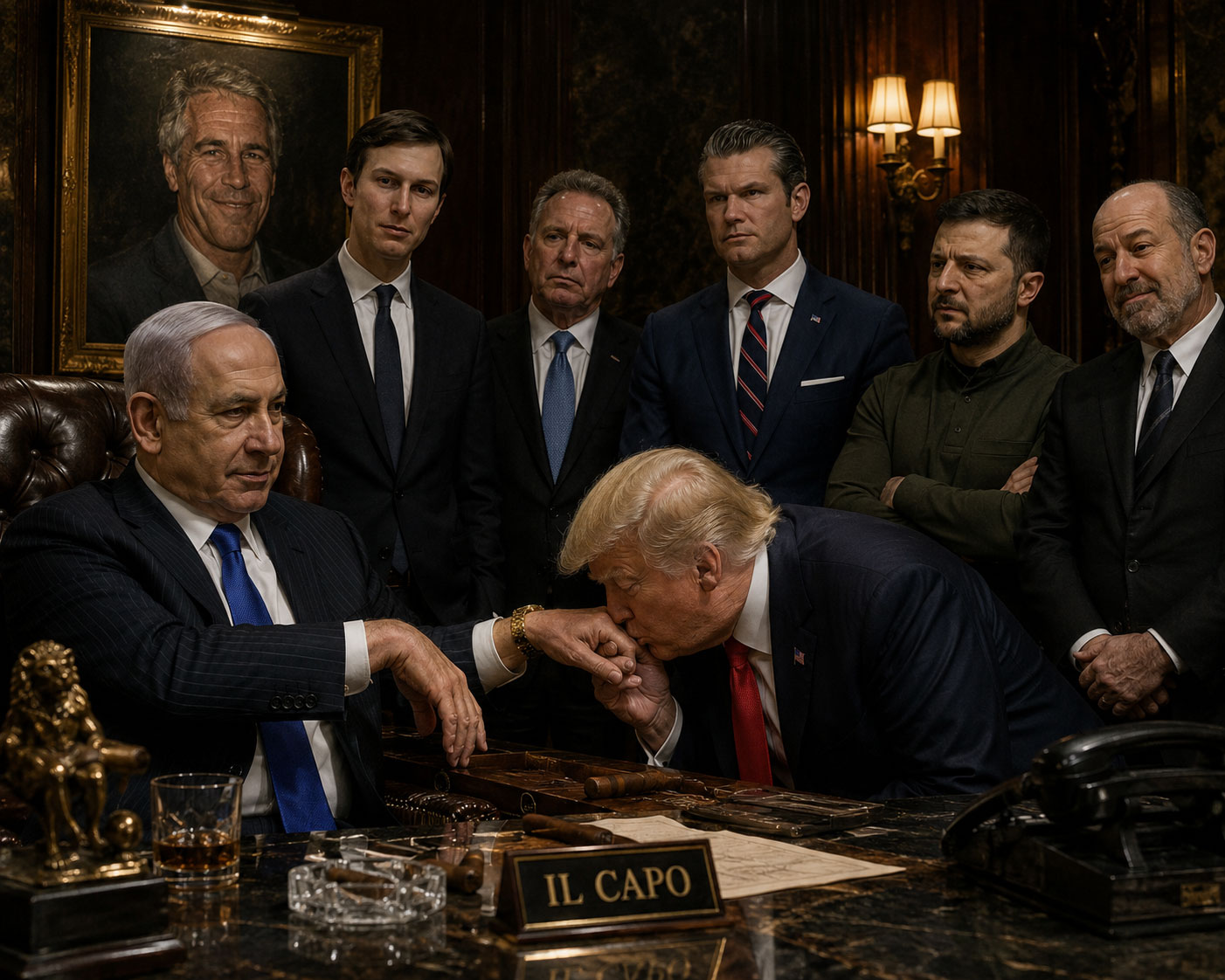
The graphic depicts a deliberately provocative political allegory: Israeli Prime Minister Benjamin Netanyahu is presented as a mafia-style “don,” while Donald Trump appears to kiss his ring. Around them stand recognizable political figures, including Jared Kushner, Steve Witkoff, Pete Hegseth, Ukrainian President Volodymyr Zelenskyy, and Howard Lutnick. On the wall hangs a portrait of Jeffrey Epstein, adding another layer of insinuation and controversy.
The image should not be read as a literal depiction of an actual meeting. It is political satire constructed through visual symbolism. Its purpose is to communicate an argument about power, influence, loyalty, and the relationships among prominent political figures—not to document an event.
The “Don” at the Center
The most important visual choice is Netanyahu’s placement in the chair and his presentation as the head of a criminal organization. The dark wood-paneled office, leather furniture, cigars, whiskey, gold ornamentation, and the desk plaque reading “IL CAPO” all reinforce the Mafia aesthetic.
The imagery deliberately borrows from the cultural language of organized crime. A Mafia boss is traditionally portrayed as someone who commands loyalty from subordinates and expects deference from those seeking his favor. By casting Netanyahu in that role, the graphic makes a highly charged political claim: that he occupies a position of unusual power and influence over the people surrounding him.
That is an allegation expressed through satire, not evidence of criminal conduct.
Trump and the Kiss of the Ring
Trump’s posture provides the graphic’s central metaphor. Rather than portraying the two men as political equals, the image reverses the expected relationship between powerful leaders. Trump bends down to kiss Netanyahu’s hand, a gesture traditionally associated with submission, allegiance, or recognition of authority.
The symbolism is intentionally exaggerated. Trump’s political persona has frequently been associated with displays of strength, dominance, and personal authority. Showing him in a submissive position therefore creates a visual contradiction designed to make the viewer ask: Who really holds the power?
The image consequently functions less as a portrait of Trump and Netanyahu than as an argument about perceived political influence.
The People Watching
The surrounding figures serve another important purpose. Kushner, Witkoff, Hegseth, Zelenskyy, and Lutnick are positioned as witnesses to the central exchange.
Their presence suggests that the supposed relationship between the two central figures has consequences beyond the individuals themselves. They represent different parts of the contemporary geopolitical and political establishment—foreign policy, business, defense, diplomacy, and political networks.
The graphic therefore creates the impression of a hierarchy: a central authority, a powerful supplicant, and a collection of influential observers.
Again, this is visual rhetoric rather than a claim that these individuals participated in such a meeting or witnessed such an exchange.
The Epstein Portrait
Perhaps the most provocative element is the portrait of Jeffrey Epstein hanging prominently on the wall.
Its function is associative rather than documentary. Epstein’s name has become a powerful symbol in public discourse surrounding elite networks, wealth, secrecy, sexual abuse, and questions about relationships between prominent people. By placing his portrait inside the fictional “mob boss” office, the artist attempts to connect the themes of political power and elite secrecy.
This is also the part of the image that requires the greatest caution in interpretation. A visual juxtaposition does not establish a factual relationship between the people depicted and Epstein, nor does it demonstrate criminal conduct by any of them.
The portrait is being used as a rhetorical device: it is intended to make the viewer associate the scene with the broader controversy surrounding powerful people, hidden networks, and accountability.
Why the Mafia Aesthetic?
The Mafia imagery works because it communicates complicated ideas almost instantly.
A boardroom could suggest bureaucracy. A diplomatic conference room could suggest formal statecraft. A Mafia office suggests something very different: loyalty, favors, personal relationships, coercion, secrecy, and informal power operating behind official institutions.
That distinction is central to the graphic’s message.
The image essentially asks the viewer to imagine that formal political institutions are only the visible layer of power—and that personal relationships and private bargains determine what happens underneath.
Whether that interpretation is fair is a separate question. The effectiveness of political satire often comes precisely from presenting an argument in an exaggerated form.
Satire Versus Factual Reporting
The graphic is best understood as political propaganda or satire rather than journalism.
Several visual clues make that clear: the exaggerated ring-kissing gesture, the “IL CAPO” sign, the cinematic Mafia setting, and the conspicuous Epstein portrait. These elements are designed to provoke an emotional reaction rather than provide evidence.
That distinction matters because realistic AI-generated imagery can blur the boundary between fiction and reality. A photorealistic image may look like a photograph even when the event depicted never occurred.
Consequently, the appropriate question is not “Did this meeting happen?” but rather:
“What political argument is the creator making by depicting it this way?”
The answer appears to be an argument about hierarchy and influence—specifically, the idea that Netanyahu possesses disproportionate influence over Trump and the political figures surrounding him, and that this influence operates through personal networks rather than purely through formal diplomacy.
The Broader Message
Ultimately, the graphic compresses several controversial political themes into one theatrical scene.
Netanyahu becomes the “boss.” Trump becomes the subordinate. The surrounding officials become witnesses or members of the wider network. Epstein becomes a symbol of elite secrecy and scandal. The dark office transforms international politics into a Mafia drama.
It is deliberately unfair in the way political caricature is often unfair. Its objective is not nuance. Its objective is to make a complicated political relationship visually unmistakable—and emotionally loaded.
The image’s power therefore comes from metaphor rather than factual representation. Its central question is about who is really calling the shots.
Whether a viewer finds that metaphor insightful, offensive, conspiratorial, or absurd will largely depend on their existing political perspective. But the visual language is unmistakable: this is a caricature of political power, constructed to portray diplomacy as a system of personal loyalty and elite influence rather than an ordinary exchange between sovereign governments.